This is a great post.
I don't think the author fully has managed to give an exhaustive description of fundamentalism, but he has identified an important component that seldom is discussed, and that needs discussion.
Monday, January 19, 2015

Wednesday, January 14, 2015
Bullshit Oscillating at 432hz: Pythagoras and Numerological Nonsense
Quite a few A432hz enthusiasts claim that only in A432hz are all the tones of the scale integers.
This is a truth with quite a bit of modification. Some of the advocates of this claim also claim that you can make your music A432hz by tuning it down using software. There are instructions all around the internet, especially on how to use Audacity to achieve such a detuning.
However, what will happen if you use Audacity to those ends is the following set of pitches:
A = 432
Bb = 457.688056763
B = 484.90360487
C = 513.737473681
This is a truth with quite a bit of modification. Some of the advocates of this claim also claim that you can make your music A432hz by tuning it down using software. There are instructions all around the internet, especially on how to use Audacity to achieve such a detuning.
However, what will happen if you use Audacity to those ends is the following set of pitches:
A = 432
Bb = 457.688056763
B = 484.90360487
C = 513.737473681
etc
Of course, the actual pitches will vary a bit from these idealized values, as singers deviate from their exact pitch both intentionally (to make their melody or harmony bit more expressive or more 'in tune' in quite a different sense from the one proposed by the A432hz enthusiasts) or by mistake. The same goes for free pitch instruments such as trombones or violins. Guitarists often have badly intonated guitars, so their pitches may also deviate quite a bit, and intentional and unintentional string bends add to the deviation there. Hammond organs have a peculiar tuning of their own that approximates regular tuning but is ever so slightly off, etc. The organ-builder may have missed by a hundredth of a millimetre the exact length a certain pipe should have been, and thus the tuning may be ever so slightly off, thus making the A:WHATEVER come out as A:WHATEVER±a bit.
Thus, the table of tunings for a small bunch of pitches provided there is only a sort of idealized average. Electronic music might get pretty close, though.
Why do the A432hz people believe that tuning to A432hz gives integer frequencies to most of or indeed to the whole scale? Many of them favor Pythagorean tuning, which is not just a question of readjusting the tuning of the reference pitch, it is a question of calculating the other pitches in other ways relative to the reference pitch. (Which requires tuning every pitch on your instrument differently, individually.)
Tuning down a song with audacity does not achieve that result. However, if you were to build your own instrument in such a way that it does have Pythagorean tuning, the idea regarding the integers will be slightly true, and I will explain why in a bit.
Why they believe that this is only achievable with A432hz is a bit less easy to understand. I have no idea, to be honest. I guess they just don't understand evidence-based thinking?
So, why does A432hz give integer frequencies with Pythagorean tuning? It's not entirely true, but it is true for the keys of C major/A minorA. Pythagorean tuning consists of tuning a bunch of new intervals by repeatedly tuning a new one up a perfect fifth, and a new one on top of that down a perfect fourth, and repeating that pair of operations (at some points, two perfect fourths will need to be added in sequence for this formulation to work, however). The untempered perfect fifth is a ratio between two frequencies, exactly 3/2. So, 100hz and 150hz are a perfect fifth apart.
We start by C256, and we immediately obtain G384. We now multiply that by 3/4 (the perfect fourth is 3/4 downwards, 4/3 upwards. Notice that 3/2 * 4/3 = 2) and get 288. We go on to obtain 432 hz, and from there we still add 324hz, 486hz, and 364.5. So, in the [256, 512]-range we have one non-integer, but since octaves correspond to doubling a frequency, that problem does disappear in the 512-1024 range, as well as even in the 432-864 range (which is of interest if we focus on A).
However, why should we construct scales using this method? This method was indeed known to the ancient Greeks but so were other methods, such as those described by Archytas, for instance. It does give very nice fifths, but it sacrifices the consonance of the major and minor thirds significantly. Unlike equal temperament, you either end up with infinitely many pitches or a wolf interval.
Pythagoras* allegedly discovered that having two things that differ by simple ratios - 2/1 or 3/2 and such - produces consonant intervals. Examples given in Pythagorean literature consist of anvils whose masses differ by such a ratio, strings of the same dimensions weighted down by weights differing by such a ratio, etc. Weird enough, the examples given in the early Pythagorean descriptions don't work - they simply do not produce results that correspond to the perfect fifth.
The piece here below that is indented might not interest all readers. It has to do with number theory and pythagorean tuning.
However, why should we construct scales using this method? This method was indeed known to the ancient Greeks but so were other methods, such as those described by Archytas, for instance. It does give very nice fifths, but it sacrifices the consonance of the major and minor thirds significantly. Unlike equal temperament, you either end up with infinitely many pitches or a wolf interval.
Pythagoras* allegedly discovered that having two things that differ by simple ratios - 2/1 or 3/2 and such - produces consonant intervals. Examples given in Pythagorean literature consist of anvils whose masses differ by such a ratio, strings of the same dimensions weighted down by weights differing by such a ratio, etc. Weird enough, the examples given in the early Pythagorean descriptions don't work - they simply do not produce results that correspond to the perfect fifth.
The piece here below that is indented might not interest all readers. It has to do with number theory and pythagorean tuning.
3/2 does produce a very consonant interval. The method I gave above is basically the same as stacking 3/2s on top of each other, and sometimes reducing them by octaves (dividing by powers of two) to keep them in the same octave - 1/1 - 3/2 - 9/4 (9/8) - 27/8 (27/16) - 81/16 (81/64) - 243/32 (243/128), etc.
Now, we need to look a bit at factorization to understand why A432 / C256 have these results.
432 factors to 2 * 2 * 2 * 2 * 3 * 3 * 3. 256 factors to 2 * 2 * 2 * 2 * 2 * 2 * 2 * 2. When multiplying, we simply concatenate the strings of factors. When dividing, we remove some shared factors:
555 / 27 = (3 * 5 * 37) / (3 * 3 * 3) = (5 * 37) / (3 * 3). 55 * 231 = (5 * 11) * (3 * 7 * 11) = (3 * 5 * 7 * 11 * 11)
This does not give us beautiful and easily comprehensible numbers, but this way of illustrating multiplication and divsion may illustrate why certain things work the way they do.
2 * 2 * 2 * 2 * 3 * 3 * 3 can obviously be divided by 3 exactly three times without yielding a non-integer. Multiplying 256 by 3/2 will be doable up to eight times until we've depleted the twos from the factorization. Since we basically alternate between adding a 3 and removing a 2 (by multiplying by 3/2), and adding a 3 and removing two 2s (when multiplying by 3/4), we can basically calculate how long it'll take to deplete the 2s - we're removing an average of one and a half per iteration, and thus we run out on the sixth iteration, which explains why the seventh tone is off by half from an integer.
By 432, we have already depleted a few 2s - we have four left. Thus, if we want to build an A major scale (which is a sequence of five leaps of fifths and one leap of 3/4 down from the starting point, including the notes at both ends, this giving us seven notes) we will deplete our 2s before getting all the way:
A: 432, E: 648, B: 486, F#: 729, C#: 546.75, G#: 820.125, D: 576
Pythagorean tuning takes one very consonant interval, and reiterates it to build a full scale. It is a useful musical scale, and probably the tuning that most medieval European music was composed in. However, it has certain issues that make almost all music composed since the renaissance fit less well with it:
- its thirds give rather dissonant chords.
- it does not form a 'cycle', it forms a 'spiral', alternatively 'it requires an infinite number of notes (or it breaks somewhere)
The first problem is the result of how dissonance works. We recall that the C major chord consists of C,E and G. We know that G is very consonant and therefore ignore that for now. We instead look at E, which is 648hz. This E is at 81/64 the frequency of C. We notice that a very nearby ratio, 80/64 = 5/4 looks fairly simple in comparison. We produce tables of overtones of the relevant notes:
The slightly lower E at 5/4 in fact has less dissonance, due to the overtones coinciding perfectly every fourth/fifth overtone for the pair C+E' , whereas the 81/64 overtones nearly never coincide and slightly more often also reach into the dissonant 'critical bandwidth'. This is actually entirely audible as well, we can compare the effect of these chords:
512 1024 1536 2048 2560 3072 3584 E' 640 1280 1920 2560 3200 E 648 1296 1944 2592 3240
Listen Music Files - Embed Audio Files - Pythagorean vs Just Intonati...
Since music is fundamentally a subjective thing, some may prefer the first chord, some may prefer the second. Personally, I find them useful for different purposes - however, the chord you get on your average guitar is a good enough approximation of both for most purposes.
Turns out the first chord type does not really 'resolve' as well as the second - if you end a song on it, there'll be the kind of feeling lingering that 'hey, this song (or part of a song) hasn't come to a halt yet'. That might be a nice effect at times - but it's not what most classical or even pop music goes for. In medieval music, this kind of chord was not used as a consonance, but a dissonance that had to be resolved, either to a perfect fifth or a perfect fifth and an octave (so, in the key of C, C+G, or C+G+c). For more information on this, see Margo Schulter's monumental website on Pythagorean tuning and medieval harmony.
Thus, if you were to somehow magically retune all the works from basically the renaissance onwards up to this day to a Pythagorean tuning, you'd end up with a lot of songs whose chord progressions do not really work as their composers have intended any longer. But who cares for the intent the composers expressed in their compositions when you have a bunch of new age gurus telling you what to do?
As for the cycle thing, we need to look at the concept of modulation and the circle of fifths. In European music, the ideas of chord progressions and of modulation both have been of quite some importance for some time now. A chord progression is a sequence of chords, and chords are sets of three (or more) notes. Most musicians do not think of the progression Am Dm Am E as fundamentally different from the progression Abm Dbm Abm Eb. They may differ in how easy or difficult they are to play on a given instrument, but essentially they have the same internal structure - in isolation, they sound very similar. This can be achieved in both equal temperament and Pythagorean tuning. But, whereas this is possible when using any note as a starting point in equal temperament, it only is possible for a limited number of starting points in Pythagorean temperament (or, you end up with an infinite number of tones you have to work with). We want a system where if a chord is the Nth chord in one key, it has the same function relative to its key as the Nth chord of the other keys. (Of course, we could probably tolerate just a few keys for which it does not hold true, but it adds complications.)
In more modern European music, it happens that the key is changed during the work. Sometimes, this even happens repeatedly. Thus, we want a large set of workable keys between which we can switch.
Further, sometimes, performers' ranges are sufficiently wide for a given work, but the absolute reach does not go sufficiently high or low. In those cases, it is convenient for musicians to adjust the piece of music so that the range of the singer (or other performer) now corresponds to the adjusted piece's demands. Our voices aren't all created the same, so flexibility in this way is very useful.
As I mentioned, Pythagorean temperament does, to some extent, satisfy these demands. However.
It necessarily contains some breaking point. We've built our scale by adding new tones that are perfect fifths apart, and we notice that the distance to the tone from which we started never is an interval we have seen before. Either we stop somewhere, or we go on forever. If we go on forever, we end up with notes whose names would be monstrosities along the lines of C######## (which would be about a fifth of a semitone sharper than G).
The twelfth tone we add is 312/2(19). As it happens, this is fairly close to 1/1. So we ignore it altogether and close our cycle there, letting the error fall on the last tone. (We could go on, and let the error fall elsewhere, but this is as convenient an ending point as we get - we don't end up with dozens of named notes, nor do we end up with a bunch of notes that are very close to each other.) Thus, the last fifth we have is of the form (3/2) / (531441/524288) - which is a very ugly interval - the first note is a perfect fifth, the other is the wolf as it would be if it were tuned to C:
Equal temperament solves this by distributing the error given previously over each fifth, having each fifth just slightly off. The difference is barely perceivable.
Now, I've gone on for quite a bit here about tuning. I don't particularly believe that equal temperament is superior in any musical sense than other tunings, but it has many advantages that explain why it is used. I am fairly convinced, however, that most repertoire since the renaissance on to this day would not work very well in Pythagorean renditions.
Because of a thing in arithmetics - viz. the n:th root of an integer will always be irrational unless that integer is another integer to the n:th power - all the frequencies we obtain, except at most one, will be irrational. Regardless if we tune to A432hz or A440hz (or any other hz whatsoever).
However, our dear A432hz enthusiasts have of course done their maths and picked their tuning system so as to have integers all the way. Yet, they do it wrong. Let's compare some different A432hz tuning tables:
Notice how the different sources do not agree on their pitches? Some of these intervals vary by as much as 22/21 (f=704 and f=672). In part this is because they use entirely different approaches to building their scale - the high 704 is not pythagorean at all despite the claims by the source, it's a way more esoteric interval (11/8). By arbitrarily picking our frequencies in such a manner, I can build an integer-only tuning based on A440, viz. A440, Bb466, B494, C523, C#554, D587, ... and this can be done for any arbitrary starting point in that region. The errors introduced for any interval by rounding the frequency to an integer number of hertz will be just slightly wider than the error of the perfect fifth in the 12-tone equal system. And that is of course an idealized error - singers, brass players, violinists, cellists, and even guitarists will regularly be further off.
Of course, ultimately, the second's length has been arbitrarily decided; we could have divided the day into ten equal hours and each hour into 100 equal units and each of those into another 100 equal units, and a tone at 432hz would now be described as ~373.248alternahz. The division of the day into 24*60*60 is arbitrary. In a world with alternahz instead of hz, other frequencies would be integers. Integer hz frequencies have no magical properties despite the dumb beliefs A432hz enthusiasts have regarding this.
But as I might have said before, if you don't like that priests, ministers, imams or rabbis tell you what music to listen to, you can always listen to new age gurus instead - they even have rituals that make your music 'spiritually permissible' (because what else does reducing its audio quality by an ever so slight amount of resampling artefacts in Audacity amount to, but a superstitious ritual - and unlike rituals by older, more well-established religions, this at least has the veneer of technology to it - but who am I kidding, it's really slightly worse than e-mailing a dozen 'hail Mary' into the digital void). Why turn to evidence-based reason when gurus make stuff so much easier? And the added anxiety from believing that Nazis have made the music you hear in the radio increase aggressiveness among your peers is certainly good for your health as well as well.
By further telling you to prefer Pythagorean tuning over other tuning methods, they're essentially imposing a certain music theory on you - one in which modulation is limited, one in which chord resolutions are much more restrictive, one in which the useful keys are much fewer and you end up having to buy new, expensive guitars because your Gibson or Martin or Taylor or Fender simply cannot be tuned in a Pythagorean fashion*. You get less, but at such a steep expense, who can refuse?
* Pythagorean guitars require complicated frets that are damn expensive to manufacture. You'll end up with one along the lines of the guitar neck pictured in this post. Those are not cheap, I can tell you. But of course, if a new age guru tells us to buy them, who are we to refuse? Who are we, indeed, to refuse?
A) A natural minor and C major contain the same seven notes. These are, when ordered as a series of fifths, F-C-G-D-A-E-B. Ordered as a regular scale they are C D E F G A B (c). (Or A B C D E F G). Think of F-C-... as though each "-" signifies "..., which equals 4/3 or 2/3 of ...", so F, which equals 4/3 of C, which equals 2/3 of G, ...
Turns out the first chord type does not really 'resolve' as well as the second - if you end a song on it, there'll be the kind of feeling lingering that 'hey, this song (or part of a song) hasn't come to a halt yet'. That might be a nice effect at times - but it's not what most classical or even pop music goes for. In medieval music, this kind of chord was not used as a consonance, but a dissonance that had to be resolved, either to a perfect fifth or a perfect fifth and an octave (so, in the key of C, C+G, or C+G+c). For more information on this, see Margo Schulter's monumental website on Pythagorean tuning and medieval harmony.
Thus, if you were to somehow magically retune all the works from basically the renaissance onwards up to this day to a Pythagorean tuning, you'd end up with a lot of songs whose chord progressions do not really work as their composers have intended any longer. But who cares for the intent the composers expressed in their compositions when you have a bunch of new age gurus telling you what to do?
As for the cycle thing, we need to look at the concept of modulation and the circle of fifths. In European music, the ideas of chord progressions and of modulation both have been of quite some importance for some time now. A chord progression is a sequence of chords, and chords are sets of three (or more) notes. Most musicians do not think of the progression Am Dm Am E as fundamentally different from the progression Abm Dbm Abm Eb. They may differ in how easy or difficult they are to play on a given instrument, but essentially they have the same internal structure - in isolation, they sound very similar. This can be achieved in both equal temperament and Pythagorean tuning. But, whereas this is possible when using any note as a starting point in equal temperament, it only is possible for a limited number of starting points in Pythagorean temperament (or, you end up with an infinite number of tones you have to work with). We want a system where if a chord is the Nth chord in one key, it has the same function relative to its key as the Nth chord of the other keys. (Of course, we could probably tolerate just a few keys for which it does not hold true, but it adds complications.)
In more modern European music, it happens that the key is changed during the work. Sometimes, this even happens repeatedly. Thus, we want a large set of workable keys between which we can switch.
Further, sometimes, performers' ranges are sufficiently wide for a given work, but the absolute reach does not go sufficiently high or low. In those cases, it is convenient for musicians to adjust the piece of music so that the range of the singer (or other performer) now corresponds to the adjusted piece's demands. Our voices aren't all created the same, so flexibility in this way is very useful.
As I mentioned, Pythagorean temperament does, to some extent, satisfy these demands. However.
It necessarily contains some breaking point. We've built our scale by adding new tones that are perfect fifths apart, and we notice that the distance to the tone from which we started never is an interval we have seen before. Either we stop somewhere, or we go on forever. If we go on forever, we end up with notes whose names would be monstrosities along the lines of C######## (which would be about a fifth of a semitone sharper than G).
The twelfth tone we add is 312/2(19). As it happens, this is fairly close to 1/1. So we ignore it altogether and close our cycle there, letting the error fall on the last tone. (We could go on, and let the error fall elsewhere, but this is as convenient an ending point as we get - we don't end up with dozens of named notes, nor do we end up with a bunch of notes that are very close to each other.) Thus, the last fifth we have is of the form (3/2) / (531441/524288) - which is a very ugly interval - the first note is a perfect fifth, the other is the wolf as it would be if it were tuned to C:
This error will also be present in any interval that "spans" this fifth. Different chords will sound drastically different, and transposing a song from one key to another may turn a chord in the song from consonant to dissonant or vice versa, ruining the song's structure altogether. (A given chord, say, 'G', will constantly be the same, of course, but what we're interesting in is retaining the structure of the scale such that, say, the chord built from the second tone of any given major key will sound sufficiently similar to every other such chord, so that we can say that it has the same 'function' relative to its key as the other 'second chords'.)
Equal temperament solves this by distributing the error given previously over each fifth, having each fifth just slightly off. The difference is barely perceivable.
Further, the fact that we've now reduced the fifth ever so slightly, adds up to four times more of a reduction of the major third - which nudges it closer to the very consonant major third in the first sound clip. And we end up with a system where each key can be used. The sample compares a pythagorean and an equal temperament fifth C-G, C-G'; the second half leaves out the lower part of the intervals so we can just compare the pitch of the two Gs. The difference is tiny.
Now, I've gone on for quite a bit here about tuning. I don't particularly believe that equal temperament is superior in any musical sense than other tunings, but it has many advantages that explain why it is used. I am fairly convinced, however, that most repertoire since the renaissance on to this day would not work very well in Pythagorean renditions.
Because of a thing in arithmetics - viz. the n:th root of an integer will always be irrational unless that integer is another integer to the n:th power - all the frequencies we obtain, except at most one, will be irrational. Regardless if we tune to A432hz or A440hz (or any other hz whatsoever).
However, our dear A432hz enthusiasts have of course done their maths and picked their tuning system so as to have integers all the way. Yet, they do it wrong. Let's compare some different A432hz tuning tables:
| 1, **2 | 3 | 4* | 5 | 6 | A440/12tet | A432/12tet | ||||
| a | 432 | 432 | 432 | 432 | 432 | 440 | 432 | |||
| a# | **461.3 | 464 | 458.21 | 466.163761518 | 457.688056763 | |||||
| b | 486 | 484 | 480 | 486 | 493.883301256 | 484.90360487 | ||||
| **518 | ||||||||||
| c | 512 | 514 | 512 | 512 | 518.2 | 523.251130601 | 513.737473681 | |||
| c# | **546.75 | 544 | 543.06 | 540 | 554.365261954 | 544.285893555 | ||||
| d | 576 | 576 | 576 | 576 | 576 | 587.329535835 | 576.650817001 | |||
| d# | **615.1 | 608 | 610.94 | 622.253967444 | 610.940258945 | |||||
| e | 648 | 648 | 640 | 648 | 648 | 659.255113826 | 647.268657211 | |||
| f | **691.2 | |||||||||
| f | 7041 | 688 | 672 | 682.66 | 691.2 | 698.456462866 | 685.75725445 | |||
| f# | **729 | 736 | 724.08 | 739.988845423 | 726.534502779 | |||||
| g | 768 | 768 | 768 | 768 | 783.990871963 | 769.736492473 | ||||
| g# | **820.15 | 800 | 814.6 | 830.60939516 | 815.507406157 |
Of course, ultimately, the second's length has been arbitrarily decided; we could have divided the day into ten equal hours and each hour into 100 equal units and each of those into another 100 equal units, and a tone at 432hz would now be described as ~373.248alternahz. The division of the day into 24*60*60 is arbitrary. In a world with alternahz instead of hz, other frequencies would be integers. Integer hz frequencies have no magical properties despite the dumb beliefs A432hz enthusiasts have regarding this.
But as I might have said before, if you don't like that priests, ministers, imams or rabbis tell you what music to listen to, you can always listen to new age gurus instead - they even have rituals that make your music 'spiritually permissible' (because what else does reducing its audio quality by an ever so slight amount of resampling artefacts in Audacity amount to, but a superstitious ritual - and unlike rituals by older, more well-established religions, this at least has the veneer of technology to it - but who am I kidding, it's really slightly worse than e-mailing a dozen 'hail Mary' into the digital void). Why turn to evidence-based reason when gurus make stuff so much easier? And the added anxiety from believing that Nazis have made the music you hear in the radio increase aggressiveness among your peers is certainly good for your health as well as well.
By further telling you to prefer Pythagorean tuning over other tuning methods, they're essentially imposing a certain music theory on you - one in which modulation is limited, one in which chord resolutions are much more restrictive, one in which the useful keys are much fewer and you end up having to buy new, expensive guitars because your Gibson or Martin or Taylor or Fender simply cannot be tuned in a Pythagorean fashion*. You get less, but at such a steep expense, who can refuse?
* Pythagorean guitars require complicated frets that are damn expensive to manufacture. You'll end up with one along the lines of the guitar neck pictured in this post. Those are not cheap, I can tell you. But of course, if a new age guru tells us to buy them, who are we to refuse? Who are we, indeed, to refuse?
A) A natural minor and C major contain the same seven notes. These are, when ordered as a series of fifths, F-C-G-D-A-E-B. Ordered as a regular scale they are C D E F G A B (c). (Or A B C D E F G). Think of F-C-... as though each "-" signifies "..., which equals 4/3 or 2/3 of ...", so F, which equals 4/3 of C, which equals 2/3 of G, ...
Monday, January 5, 2015
An Appendix: Dissonance and Consonance
Consonance and dissonance are traits we ascribe to sounds. Thus, our perception of sounds is somewhat important to this classification. Clearly, it's not a fully objective quality.
In the main post, I note how Pythagoras contributed to the understanding of harmony. Although Pythagoras did not understand what sound was, he did understand that relating the sizes of the objects on which you play (say, different lengths of otherwise identical strings) by simple ratios produced appealing sounds. There have been a number of hypotheses as to why this would be the case. The most widely accepted one these days relates to the harmonics (overtones) described previously.
If we add together two sine waves, a and b, of rather similar frequencies, the resulting wave will have a complication - its amplitude changes periodically in a wave-like way:
I previously mentioned overtones. These provide us with the actual explanation! To calculate the dissonance for an interval, we should actually look at the amount of overtones for each of the tones in the interval that come within each others' critical bandwidths. The relative amplitudes of course also contribute, but in ways that is less easy to investigate by just eyeballing a graph.
Let us compare two intervals. A440 and E660 vs. A440 and D#622. (Note: for ease of calculation, I have reduced the usual D# by an ever so slight bit.) These have the following overtone series:
Relative amplitude of the overtones is relevant, but we're not going to look at that now. More detailed models for understanding dissonance exist (e.g. 'harmonic entropy'), but this post is mainly meant as an appendix to an upcoming piece of reasoning about scale construction (that is part of a greater piece of reasoning regarding claims made by A432hz enthusiasts). Harmonic entropy has been used by people interested in scale construction, and various predictions made by it seem to have been accurate.
Anyways, this is a very short introduction to the issues of consonance and dissonance, and one where further complications can ensue - instruments where the overtones are not integer multiples of the fundamental, for instance, have their own complications with regards to what intervals are consonant and what intervals are dissonant.
If we add together two sine waves, a and b, of rather similar frequencies, the resulting wave will have a complication - its amplitude changes periodically in a wave-like way:
 |
| Sum of sin(tx) and sin(ytx), where y is a constant relatively close to 1, and t is an arbitrary constant. I have no idea what causes the graphical misshap close to the second through. Picture from wolframalpha.com, try out sin(x) + sin(yx), with y≃1 there for a variety of y. |
The frequency of this "metawave" is the same as the difference between the two frequencies a and b. If the difference is small, it does not sound bad - just like a slight wavering volume, somewhat similar to a vibrato in sound, and if it is large we don't perceive it as dissonant either. The range in which we perceive dissonance is called the critical bandwidth. Empirical research has shown that it covers a range from about a handful hertz to 6/5 of the frequency. However, this might seem to fail to explain dissonances over wider ranges, such as the major seventh (which is roughly 15/8, which clearly is wider than 6/5) or the very dissonant tritone (which is sqrt(2), which is a bit less than (6/5)^2, and thus clearly wider than 6/5).
I previously mentioned overtones. These provide us with the actual explanation! To calculate the dissonance for an interval, we should actually look at the amount of overtones for each of the tones in the interval that come within each others' critical bandwidths. The relative amplitudes of course also contribute, but in ways that is less easy to investigate by just eyeballing a graph.
Let us compare two intervals. A440 and E660 vs. A440 and D#622. (Note: for ease of calculation, I have reduced the usual D# by an ever so slight bit.) These have the following overtone series:
We can see that the A column (the one starting out with 440), and the E column (660) often coincide. Even if they didn't perfectly coincide (say, we replaced 660 with 659 or 661), the numbers would be close, and thus not reach the requisite width to enter into the critical bandwidth until several overtones down the line. However, 622 quickly enters it - 1320 is within the critical bandwidth of 1244 (or rather, they're within each other's range), 1866 is within the critical bandwidth of 1760, etc. Sure, 1980 is within the critical bandwidth of 2200 too, so E will cause some slight dissonance. However, the further up the overtone series we have to go to find critical bandwidth issues, the less dissonant an interval is. Of course, timbre may also affect the dissonance - clarinets and many woodwinds lack even-integer overtones (so, a tone sounding at a 100hz will only have overtones at 300hz, 500hz, etc), and for a good enough analysis, we would have to look into them as well.
A 440 D# 622 E 660 A 880 d# 1244 e 1320 1320 a 1760 a# 1866 b 1980 c 2200 d# 2488 e 2640 2640 g* 3080 3110 g# 3300 . . .
Relative amplitude of the overtones is relevant, but we're not going to look at that now. More detailed models for understanding dissonance exist (e.g. 'harmonic entropy'), but this post is mainly meant as an appendix to an upcoming piece of reasoning about scale construction (that is part of a greater piece of reasoning regarding claims made by A432hz enthusiasts). Harmonic entropy has been used by people interested in scale construction, and various predictions made by it seem to have been accurate.
Anyways, this is a very short introduction to the issues of consonance and dissonance, and one where further complications can ensue - instruments where the overtones are not integer multiples of the fundamental, for instance, have their own complications with regards to what intervals are consonant and what intervals are dissonant.
Friday, December 26, 2014
Bullshit Oscillating at 432Hz: On Resonance
One concept often referred to by the 432hz enthusiasts is 'resonance'. Apparently, things in the world resonate "at 432hz" in ways that ... I dunno. Magic. They're not all that clear on what resonance actually is, nor do they want to clarify exactly what they thing it does to things, except it's clearly good and magical.
They think the 'universe' itself resonates at 432hz, but also that pretty much each of its component parts has that same magical resonance. Everything, of course, is vibrations, and so on. It's a cornucopia of vibrations, resonances and frequencies. What else is there to expect when new age kooks are involved? Sigh.
I previously talked about the speed of sound. (Which confusingly enough also is called 'c'. Thanks, science, was that the best letter you got?) This is a somewhat relevant part of resonance. If a system resonates at a frequency, this means it reinforces that frequency. A system may resonate at several different frequencies, and even simultaneously so. A frequency is reinforced if its wavelength in that material (say, a string) corresponds to the length of that string or a half or third or n:th part of its length.
A relevant example of just how dumb the A432hz claims are, is the claim that Stradivarius violins have exceptional resonance at A432hz. We will now look at why that claim is genuinely dumb.
Resonance in a violin depends on the speed of sound in the relevant kind of wood, the shape of the wooden parts, and a variety of other things. However, there are interesting complications in how resonance in violins works with regards to actual musical use.
Ever noticed how synth strings sound comparatively lifeless compared to the violin? In part, this is because violin resonance is not uniform. When you play a tone, say, A440, the string also produces harmonics. These are integer multiples of the fundamental frequency - you get something along the lines of A440, a880, e'1320, a'1760, c#''2200, e''2640, ... and each of these has its own amplitude. However, different frequencies resonate differently in the violin body. Thus, when you play A440 or you play B495 (with the harmonics b990, f#'1485, b'1980, d#'2475, ...) the relative amplitude of the harmonics will not be the same for B495 as they would have been for A440.
If you are mathematically inclined, you could best imagine what happens as a function along these lines:
a1sin(x) + a2sin(2x) + a3sin(3x) + ... + ahsin(hx), where all h are integers, and ah are values in the range [0, 1]. ah goes to zero as h goes to infinity. Essentially, the faster the oscillation of some overtone, the smaller the width that that oscillation imparts to the waveform. However, in the case of an acoustic instrument, this abstracts away the importance of the fact that ah is not the same for each hx! Thus, it'd be better to have
f(x)sin(x) + f(2x)sin(2x) + f(3x)sin(3x) + ... + f(hx)sin(hx), where f(hx) gives the amplitude for that particular frequency, and f(x) is (most likely) a continuous function that goes to zero as x goes to infinity - but oscillates quite a bit on the way.
For people for whom maths is difficult to keep up with: the timbre of an instrument is the result of lots of waves, that interrelate in this way: in the time the lowest wave goes /\, the next-lowest goes /\/\. There's even a further one that goes /\/\/\ in the same time, and so on. However, the faster they go, the less high they go.
Some pictures! Let us pay no heed to the actual values along the x-axis now - the same "relative" situation will obtain for any note. We have several wave forms which if we were to separate them we'd obtain graphs like these describing them. The first few pictures below here are in the sequence sin(x), sin(2x), sin(3x), sin(4x), sin(5x):

We call the lowest frequency in a tone its 'fundamental', and that frequency is generally the frequency we will say the tone 'has'.


These waves happen together, but their amplitudes are different. If we were to plot them all on the same curve, we'd get something like this (amplitudes subject to variation):

How high (and low) each wave goes is determined by the factor I previously labelled ah, so in this case a3 is 0.7, a4 is 0.5, etc. If we were to add together (sin(x) + sin(2x) + ... + sin(4x), we would obtain something like this:

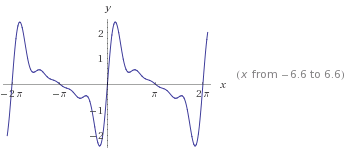
If you keep adding more 'partials' to it or just alter the amplitude of any one partial wave, the wave form will slightly change but the pattern we have here will be recognizable there. However, in reality the faster waves will more often not reach 'as high' and 'as low' as the slower waves. The graph below illustrates another similar pattern:

The ear is surprisingly good at recognizing differences between different-shaped waves of these kinds - that is in part how we recognize trumpets from clarinets from violins from guitars, or even how we distinguish different vowels. Of course, if the difference is subtle enough, it will not necessarily be recognized at all.
Furthermore, our ear-brain interface is so used to waves being related by integer factors that if you were to hear a wave of this form: a2 * sin(2x) + a3 * sin(3x) + a4 * sin(4x) + ... your brain would fill in the missing sin(x) for you!
Now, when a violinist plays, he will often impart a vibrato - he will repeatedly continuously alter the frequency slightly over a certain range of frequencies. The resonances will also change, due to the aforementioned phenomenon – resonances differing for different frequencies and thus the shape will change. This is what makes the violin sound comparably more 'alive' than a synth tone. It seems good quality violins even have drastic changes in timbre over short ranges, and thus the shape of the wave that is produced at different fundamental frequencies. So, how does the physics of that work out?
Resonance is the result of standing waves and other similar things, and standing waves occur when the wave length of a tone is the same - or a divisor - of the length of the thing in which the vibration happens. Since the violin contains many lengths, a line in the violin body that happens to have such a length will start vibrating at such a frequency (and lines with approximately the same frequency may start vibrating too).
Look at the shape of the violin body. You may notice that it is not a circle or a sphere, but rather a shape with some complications to it. This means that depending on where in the wood or where in the air inside of the resonance chamber you draw a straight line, you'll have a different length - thus also a different set of frequencies resonating along that line. Since the wood does not have a perfectly identical density throughout, this may affect the resonance slightly at different frequencies.
So what if a Stradivarius violin resonates well at A432? It resonates well - and in different ways - throughout its entire range! And the variations in resonance are intentional! What of course makes the use of this pretend evidence even more interesting is that Stradivariuses have been proven not to sound 'superior' in double-blind tests: high quality modern violins, as well as high-quality antique violins of other skilled luthiers have been ranked the same in such tests. Simply put: if we believe that a musician is playing a Stradivarius, we trick our brain into thinking it sounds better than we would think if we knew he was playing a modern high-end violin. Certainly the Stradivarius violins are not bad, they're quite great instruments - but there is nothing magically perfect about them. It's interesting indeed that the A432hz enthusiasts are willing to use irrelevant, debunked and disproved reasoning, as well as name-dropping to bolster their case.
Furthermore, it is well known that violinists tend to use vibrato, a method wherein the pitch of the tone they are playing is periodically altered - basically it glides audibly between an upper and a lower pitch slightly off from the tone they are playing. The above variety in resonance makes this effect not only produce an alteration in pitch level, but also a slight alteration in timbre. This even further makes violins sound appealing to us, in a way that a single frequency's magical resonance properties wouldn't have any relevance to whatsoever.
What is more, there is a problem when the whole instrument resonates very well at some frequency. This is one of two phenomena that go by the name 'wolf tones'. Due to strong resonances when the whole instrument resonates, even nearby tones may cause an awkward, ugly sound. Jamie Buturff says:
Chances are, however, that they just claim that A432 is the main resonance of the Stradivarius violins, since this is a nice soundbite. I would even bet they just made it up.
Violins sound good not because a certain frequency resonates, but because of the complex interaction of resonance strengths for different overtones. A432-enthusiasts will never care about the actual physics of music, though, so can be dismissed as ignorant woo-peddlers.
They think the 'universe' itself resonates at 432hz, but also that pretty much each of its component parts has that same magical resonance. Everything, of course, is vibrations, and so on. It's a cornucopia of vibrations, resonances and frequencies. What else is there to expect when new age kooks are involved? Sigh.
I previously talked about the speed of sound. (Which confusingly enough also is called 'c'. Thanks, science, was that the best letter you got?) This is a somewhat relevant part of resonance. If a system resonates at a frequency, this means it reinforces that frequency. A system may resonate at several different frequencies, and even simultaneously so. A frequency is reinforced if its wavelength in that material (say, a string) corresponds to the length of that string or a half or third or n:th part of its length.
A relevant example of just how dumb the A432hz claims are, is the claim that Stradivarius violins have exceptional resonance at A432hz. We will now look at why that claim is genuinely dumb.
Resonance in a violin depends on the speed of sound in the relevant kind of wood, the shape of the wooden parts, and a variety of other things. However, there are interesting complications in how resonance in violins works with regards to actual musical use.
Ever noticed how synth strings sound comparatively lifeless compared to the violin? In part, this is because violin resonance is not uniform. When you play a tone, say, A440, the string also produces harmonics. These are integer multiples of the fundamental frequency - you get something along the lines of A440, a880, e'1320, a'1760, c#''2200, e''2640, ... and each of these has its own amplitude. However, different frequencies resonate differently in the violin body. Thus, when you play A440 or you play B495 (with the harmonics b990, f#'1485, b'1980, d#'2475, ...) the relative amplitude of the harmonics will not be the same for B495 as they would have been for A440.
If you are mathematically inclined, you could best imagine what happens as a function along these lines:
a1sin(x) + a2sin(2x) + a3sin(3x) + ... + ahsin(hx), where all h are integers, and ah are values in the range [0, 1]. ah goes to zero as h goes to infinity. Essentially, the faster the oscillation of some overtone, the smaller the width that that oscillation imparts to the waveform. However, in the case of an acoustic instrument, this abstracts away the importance of the fact that ah is not the same for each hx! Thus, it'd be better to have
f(x)sin(x) + f(2x)sin(2x) + f(3x)sin(3x) + ... + f(hx)sin(hx), where f(hx) gives the amplitude for that particular frequency, and f(x) is (most likely) a continuous function that goes to zero as x goes to infinity - but oscillates quite a bit on the way.
For people for whom maths is difficult to keep up with: the timbre of an instrument is the result of lots of waves, that interrelate in this way: in the time the lowest wave goes /\, the next-lowest goes /\/\. There's even a further one that goes /\/\/\ in the same time, and so on. However, the faster they go, the less high they go.
Some pictures! Let us pay no heed to the actual values along the x-axis now - the same "relative" situation will obtain for any note. We have several wave forms which if we were to separate them we'd obtain graphs like these describing them. The first few pictures below here are in the sequence sin(x), sin(2x), sin(3x), sin(4x), sin(5x):
The second frequency is an octave above the first - notice how the number of peaks or troughs is twice that of the previous waveform.
An octave and a fifth above the fundamental, we have the third frequency - its troughs and peaks number thrice that of the fundamental.
Double octave, followed by major third over double octave:
These waves happen together, but their amplitudes are different. If we were to plot them all on the same curve, we'd get something like this (amplitudes subject to variation):
How high (and low) each wave goes is determined by the factor I previously labelled ah, so in this case a3 is 0.7, a4 is 0.5, etc. If we were to add together (sin(x) + sin(2x) + ... + sin(4x), we would obtain something like this:
If, however, we were to add together those given in the multiwave graph I just posted, we would obtain this:
The ear is surprisingly good at recognizing differences between different-shaped waves of these kinds - that is in part how we recognize trumpets from clarinets from violins from guitars, or even how we distinguish different vowels. Of course, if the difference is subtle enough, it will not necessarily be recognized at all.
Furthermore, our ear-brain interface is so used to waves being related by integer factors that if you were to hear a wave of this form: a2 * sin(2x) + a3 * sin(3x) + a4 * sin(4x) + ... your brain would fill in the missing sin(x) for you!
Now, when a violinist plays, he will often impart a vibrato - he will repeatedly continuously alter the frequency slightly over a certain range of frequencies. The resonances will also change, due to the aforementioned phenomenon – resonances differing for different frequencies and thus the shape will change. This is what makes the violin sound comparably more 'alive' than a synth tone. It seems good quality violins even have drastic changes in timbre over short ranges, and thus the shape of the wave that is produced at different fundamental frequencies. So, how does the physics of that work out?
Resonance is the result of standing waves and other similar things, and standing waves occur when the wave length of a tone is the same - or a divisor - of the length of the thing in which the vibration happens. Since the violin contains many lengths, a line in the violin body that happens to have such a length will start vibrating at such a frequency (and lines with approximately the same frequency may start vibrating too).
Look at the shape of the violin body. You may notice that it is not a circle or a sphere, but rather a shape with some complications to it. This means that depending on where in the wood or where in the air inside of the resonance chamber you draw a straight line, you'll have a different length - thus also a different set of frequencies resonating along that line. Since the wood does not have a perfectly identical density throughout, this may affect the resonance slightly at different frequencies.
So what if a Stradivarius violin resonates well at A432? It resonates well - and in different ways - throughout its entire range! And the variations in resonance are intentional! What of course makes the use of this pretend evidence even more interesting is that Stradivariuses have been proven not to sound 'superior' in double-blind tests: high quality modern violins, as well as high-quality antique violins of other skilled luthiers have been ranked the same in such tests. Simply put: if we believe that a musician is playing a Stradivarius, we trick our brain into thinking it sounds better than we would think if we knew he was playing a modern high-end violin. Certainly the Stradivarius violins are not bad, they're quite great instruments - but there is nothing magically perfect about them. It's interesting indeed that the A432hz enthusiasts are willing to use irrelevant, debunked and disproved reasoning, as well as name-dropping to bolster their case.
Furthermore, it is well known that violinists tend to use vibrato, a method wherein the pitch of the tone they are playing is periodically altered - basically it glides audibly between an upper and a lower pitch slightly off from the tone they are playing. The above variety in resonance makes this effect not only produce an alteration in pitch level, but also a slight alteration in timbre. This even further makes violins sound appealing to us, in a way that a single frequency's magical resonance properties wouldn't have any relevance to whatsoever.
What is more, there is a problem when the whole instrument resonates very well at some frequency. This is one of two phenomena that go by the name 'wolf tones'. Due to strong resonances when the whole instrument resonates, even nearby tones may cause an awkward, ugly sound. Jamie Buturff says:
We're stuck to 440Hz and are the whole day covered in this "not related" music! It is clear that we must return to the natural vote of 432 Hertz. A Stradivarius violin resonance is at 432Hz, it's built to do so. [Jamie Buturff, The Frequency of the Universe]If Jamie Buturff were correct, A432 would sound like shit on that violin, since you'd end up having a lot of unwanted resonances and a strong spike in volume for that exact frequency! The A432 community are idiots who don't know the first thing about acoustics, yet pontificate about it as though they were experts.
Chances are, however, that they just claim that A432 is the main resonance of the Stradivarius violins, since this is a nice soundbite. I would even bet they just made it up.
Violins sound good not because a certain frequency resonates, but because of the complex interaction of resonance strengths for different overtones. A432-enthusiasts will never care about the actual physics of music, though, so can be dismissed as ignorant woo-peddlers.
Monday, December 22, 2014
Bullshit Oscillating at 432 Hz: A Primer on Acoustics
This is some prerequisite material to understand some of the relevant ideas which the A432-community utterly fail to grasp or account for.
Bullshit Oscillating at 432 Hz: A Primer on Acoustics
Sound consists of fast, relatively small oscillating changes in pressure (and for most hearing-related purposes, air is the medium in which these changes take place and travel). Air is rarefied and compressed due to the interaction of atoms - basically, they push each other out, and are pushed back in return. You have probably seen spectral diagrams of songs and sounds. These basically map relative pressure at some spatial point at any given moment onto the vertical axis, and time onto the horizontal axis.
Amplitude correlates with volume, and basically measures how greatly the atoms are offset.
Tones are a special kind of sounds – they are the subset that have regularly recurring peaks and troughs. That is, if the time it takes for the wave to go from one top to the next is the same for a lot of peaks, you are dealing with a tone. A complication exists, though: most things that produce regular waveforms of this kind, also produce other waveforms simultaneously! A string or organ pipe or glass of water that is agitated to produce a frequency f, also produces a set of other frequencies, called overtones or harmonics. In most musical instruments, these are integer multiples of f, where f signifies the frequency of whichever tone we are discussing at the time: 2f, 3f, 4f, ... The amplitude generally is lesser with each new note as we ascend this series, but exceptions exist. A simple example of that is the clarinet, where even frequency multiples are entirely omitted, thus leading to the situation where amp(odd number * f) > amp(even number * f), even if the odd number is way greater than the even number. Some instruments also may have other exceptions. One final set of exceptions is that not all instruments have exclusively integer multiples - most pianos have near-integer multipes, and bells can have really complicated multiples. Many percussive instruments are exceptions as well.
This will be relevant when looking at the misconceptions about scales and harmony that the A432-community labours under.
Sound travels at roughly 344 meters per second in air (subject to changes due to changes in temperature, dryness, etc). Inversely, the length between the peaks of the waveform for a tone at frequency x is 344./x meters. So, 344 hz in air would have the wave length of approximately one meter. However, assuming no wind, if the speaker were travelling along a straight line at 10 meters per second, a stationary listener in front of the speaker would hear 354 hz. The speed of the speaker is not added to the speed of sound – the speed of sound is entirely relative to the medium in which it travels. So, the number of wavepeaks that reach the listener will increase, as the distance between the wave peaks is reduced (or the opposite, if he is travelling the other way). This is known as the Doppler effect. The Doppler effect is nice in that it conserves intervals - if the speaker switched to playing a frequency that is y times 344hz, the listener would hear y times 354hz.
The formula is f' = f * (c + v)/c, where c = the speed of sound in the relevant medium, and v = velocity of the speaker. More generally, it is f' = f * (c + vs)/(c + vl), where vs and vl are the speed of the speaker and the listener along the line. Calculating it if the movement vectors are not on a line is more complicated, but we will ignore that for now. Since we are dealing with a factor, overtones will be affected proportionally - ((f * (c + vs))/c) / ((f * 2(c + vs))/c)) = (f)/(f * 2) = r – overtones or sets of frequencies will be related by the same factor r (not by the same difference in exact number of hertz).
It turns out our hearing is mostly logarithmic – we do not hear an absolute difference in hertz as a meaningful way of classifying how tones relate. 400hz and 450hz simultaneously sounds different from 300hz and 350hz simultaneously - but not just because the latter pair is lower! 400hz and 450hz simultaneously sounds as though the two notes relate in the same way that 300hz and 337.5hz do – the pairs share the same ratio, and therefore we hear these pairs as similar. This is also relevant when looking at the misconceptions and misinformation the A432 community spread about scales.
In other gasses, liquids or solids, sound travels at other speeds (and in solids, there evens exist two 'different kinds' of sound, travelling at different speeds - sheer waves and compression waves). Sound travelling in your body travels at another speed than sound travelling in the surrounding air – and this may further differ between your bones, your muscles, your skin, your intestines, etc.
If an orchestra is playing outdoors in A432 upwind from you, and the wind is six meters per second, you will hear it play in A440. If it is downwind from you, you will hear it play in roughly A424. We find this by dividing 440/432, then solving (c + vs)/c = 440/432, where c = 344, thus (344 + vs)/344 = 440/432. This is equivalent to 1 + vs/344 = 1 + 8/432 ≡ vs/344 = 8/432 ≡ vs/43 = 4/27 ≡ vs = 162/27 = 6.
This will be relevant later on when looking into cymatics, a scientific method thoroughly misunderstood by the A432 community.
Sunday, December 21, 2014
Bullshit oscillating at 432hz
For the next topic, I will write a rebuttal to one very mistaken theory about music that is making the rounds on the internet, and that also has a number of adherents - even among real musicians.
This theory sometimes is coated in new age-inspired pseudoscientific terminology, and sometimes it is bundled with a conspiracy theory. A small minority seems not to hold any specific pseudoscientific stances, but appear to just go along with the bandwagon in order to utilize the additional traction for support the tuning standard in general that the new-agers and conspiracy nuts would . I will investigate the (in)validity of almost all the arguments presented.
432hz adherents believe that if we retuned the western scale so that A440 was replaced by A432, music would be more harmonious, and we'd be more happy and peaceful, and I really have to restrain myself not to say something silly like 'and Jesus would come back and lions and lambs would spoon together'.
This will, again, be thoroughly detailed. The point with it will be to show just how lacking of any rational ground to stand on a lot of the A432 claims are. I am also interested in debating this with adherents, so if you believe that A432 has weird mystical properties, please contact me and try to convince me differently. I will present your argumentation exactly as it is, and respond to it with serious arguments.
This theory sometimes is coated in new age-inspired pseudoscientific terminology, and sometimes it is bundled with a conspiracy theory. A small minority seems not to hold any specific pseudoscientific stances, but appear to just go along with the bandwagon in order to utilize the additional traction for support the tuning standard in general that the new-agers and conspiracy nuts would . I will investigate the (in)validity of almost all the arguments presented.
432hz adherents believe that if we retuned the western scale so that A440 was replaced by A432, music would be more harmonious, and we'd be more happy and peaceful, and I really have to restrain myself not to say something silly like 'and Jesus would come back and lions and lambs would spoon together'.
This will, again, be thoroughly detailed. The point with it will be to show just how lacking of any rational ground to stand on a lot of the A432 claims are. I am also interested in debating this with adherents, so if you believe that A432 has weird mystical properties, please contact me and try to convince me differently. I will present your argumentation exactly as it is, and respond to it with serious arguments.
Saturday, December 6, 2014
On Context, Isaiah and the Reason for the Season
Language is maybe the most important tool we humans have at our disposal. Using it and its even more specialized variety 'meta-language', we have been able to develop maths, science and so on. However, sometimes, we do not see the forest for all the trees - we miss the context because we are blinded by words.
So, let us have a look at a prophecy where a lot of the discussion back and forth entirely misses the point of the text being discussed. The Christian idea that Jesus was born of a virgin has its roots in the Septuagint translation of the Old Testament, and the evangelists' use of one particular verse.
A lot of the further discussion of this topic basically is philological - does the term almah signify a young woman in general or does it signify a virgin? Arguments in favor of young woman seem way more solid, and even the Greek parthenos seems less clearly to have signified virgins than previously assumed, thus we cannot even be sure that the LXX translators intended the meaning 'virgins'. Further, it seems the texts of the LXX that are accessible to us are all from traditions maintained by Christian scribes, so that weakens the case in favour of virgin a bit as well.
However, there are good reasons even if almah meant virgin to understand the text as not at all being a prophecy about Jesus - and this even if we grant the assumption that God exists, can promise things he fulfills in the future, and also knows the future. These are not assumptions I believe to be true, but let us be magnanimous for a moment!
Therefore the Lord himself shall give you a sign; Behold, a virgin shall conceive, and bear a son, and shall call his name Immanuel.
What does any reader in the west when he comes across this verse in isolation think of? Alas, this blinds us to the meaning of the context in which it is found! So strong are our associations, that they blank our minds for a while, our reading comprehension fails.
I have even seen people rejecting the idea that this was written before Jesus was born on the grounds that 'since prophecy really does not exist, Isaiah cannot have predicted an alleged virgin birth, thus it must have been written after the idea of Jesus' virgin birth had taken hold in order to fabricate a prophecy'. This is not a common misunderstanding, but it still shows how relatively reasonable skeptics just fail to read it in context.
Of course, context is a magic word in other ways too - how often do not Christian apologists tell us we must read things in context, meanwhile trying to divert our attention from that very context? In this case, they do not even need to do that, though, since centuries of indoctrination has overruled our reading comprehension.
So, let us look a bit closer at what Isaiah actually says. I will not bother to go through the Hebrew text here, since the English is sufficient to illustrate the point I am making. This is partially based on the exegesis found here[1].
And it came to pass in the days of Ahaz the son of Jotham, the son of Uzziah, king of Judah, that Rezin the king of Syria, and Pekah the son of Remaliah, king of Israel, went up toward Jerusalem to war against it, but could not prevail against it.
And it was told the house of David, saying, Syria is confederate with Ephraim. And his heart was moved, and the heart of his people, as the trees of the wood are moved with the wind.
So, removing the extra verbiage, Ahaz, king of Judah, learned that Rezin and Pekah, kings of Syria and Israel, were in cahoots to attack him. He was distressed by this. It would seem the author inserts stuff from a later vantage point - "but could not prevail against it" seems to be an indication as to how the narrative will conclude as far as the military campaign goes.
Then said the LORD unto Isaiah, Go forth now to meet Ahaz, thou, and Shearjashub thy son, at the end of the conduit of the upper pool in the highway of the fuller's field; And say unto him, Take heed, and be quiet; fear not, neither be fainthearted for the two tails of these smoking firebrands, for the fierce anger of Rezin with Syria, and of the son of Remaliah. Because Syria, Ephraim, and the son of Remaliah, have taken evil counsel against thee, saying, Let us go up against Judah, and vex it, and let us make a breach therein for us, and set a king in the midst of it, even the son of Tabeal: Thus saith the Lord GOD, It shall not stand, neither shall it come to pass.
So, God tells Isaiah to talk to King Ahaz, to tell him not to fear. For the record, Ahaz was not a particularly righteous king. Next, God's promise to Ahaz is given in greater detail:
For the head of Syria is Damascus, and the head of Damascus is Rezin; and within threescore and five years shall Ephraim be broken, that it be not a people. And the head of Ephraim is Samaria, and the head of Samaria is Remaliah's son. If ye will not believe, surely ye shall not be established.
The promise, quite clearly, is that Syria and Samaria will be crushed. But God has more to say, relating to this very promise about Syria and Samaria.
Moreover the LORD spake again unto Ahaz, saying,
Ask thee a sign of the LORD thy God; ask it either in the depth, or in the height above.
But Ahaz said, I will not ask, neither will I tempt the LORD.
So, God wants Ahaz to ask for a sign by which God can affirm this promise - a little miracle to show that he is up to his promise. Ahaz, however, scoffs at this.
And he said, Hear ye now, O house of David; Is it a small thing for you to weary men, but will ye weary my God also? Therefore the Lord himself shall give you a sign; Behold, a virgin shall conceive, and bear a son, and shall call his name Immanuel.
So, God himself picks the sign(, and as it turns out decides to renege on what he just told Ahaz). Here, of course, we run into the place where the virgin birth famously is promised. Looking closer at the Hebrew - provided that we grant that Almah is virgin - we find that it is not "a virgin", but "the virgin"; it is also preceded by the somewhat demonstrative הִנֵּה, and thus it seems even more likely the author of this narrative thought of it as the prophet actually pointing out one particular virgin. Of course, there's no oddity about pointing out that someone who currently is a virgin will conceive. She may no longer be a virgin when the conception occurs, obviously, but we may very well identify a person by what qualities they have in the present, regardless of their qualities at another time. However, even then we have good reasons to think it's not 'virgin' that is the intent of the text. Why should anyone think the sign God is giving to Ahaz is the birth of the Messiah? Nothing in the context this far indicates that such an interpretation is valid.
Butter and honey shall he eat, that he may know to refuse the evil, and choose the good.
For before the child shall know to refuse the evil, and choose the good, the land that thou abhorrest shall be forsaken of both her kings.
So, the sign by which God will affirm that he has the power to fulfill his promise, is that what he promises will be fulfilled before the boy reaches his teenage years. This is not a very useful sign - it is like "to prove to you that I can repay this loan within ten years, I will repay this loan within ten years". This is really an insult to Ahaz, God is giving a useless sign as a rhetorical device.
The promise is now turned pretty much upside down, with God promising terrible things to befall the kingdom of Judah. So, in case this prophecy really is about virgin births, we must have a virgin birth of the time-keeping boy in king Ahaz time and later on, we have Jesus. That is mighty odd, is it not? However, this means we have a clear idea what the text actually is saying, and the usual understanding that pretty much everyone has if asked what that particular verse means appears incongruous.
Even when reading the text by oneself, it is likely that one reads the bit about the conception and birth as though the prophet temporarily diverts from the affairs of the day to a prophecy centuries into the future and then jumps back to the main topic - as though he was incapable of keeping to a topic.
There still is literature that assumes Isaiah 7:14 is representative of Jewish beliefs about the Messiah, without having looked at any other evidence about the verse in question than its Christian interpretation. This is a pretty important fact regarding how people tend to think of Judaism.
Now, I am not just pointing out what Isaiah actually was saying, I am making a point that this is just one example of - associations that words or phrases have in our minds somehow trumping the actual meaning of the text or utterance, breaking our reading comprehension (or listening comprehension) temporarily. It is a problem lots of people run into, and sometimes makes people come up with ludicrous ways out of the mistaken ideas it causes them - such as the example I mentioned with a skeptic denying that Isaiah could have been written before the birth of Jesus.
In part I suspect this relates to how language works - our brains are pattern-matching algorithms, and a word, a phrase or even a whole poem can trigger associations. Often, these associations are not particularly complicated - but the same word may trigger slightly different associations for each one of us. However, the environment in which most native speakers of English have grown up make Behold, a virgin shall conceive trigger an association with several of Christianity's central tenets. Some other phrases and words may have a comparable power in distorting how we understand a text or utterance, and it is important that we realize that our minds are not immune to this.
[1] Rabbi Tovia Singer, Dual Prophecy and the Virgin Birth,
Outreach Judaism, http://outreachjudaism.org/dual-prophecy-virgin-birth/
All other quotes from Isaiah 7, King James Version.
Subscribe to:
Posts (Atom)